Ticket to Dice - Trains Tracks
- 4.4
- Rating
- 10.00K
- Installs
- Free
- Price
 Analysis by App-foxy
Ticket to Dice - Trains Tracks is a free board game from FunCraft Games that turns a familiar train-route idea into a quicker, dice-driven contest across the USA. I found its appeal easy to understand: it gives me the satisfying decisions of claiming connections while adding enough luck to keep every turn uncertain. It is not a deep strategy simulator, and it does not try to replace a full tabletop session with a large group. Instead, it works best as a light, approachable game for short bursts when I want to make a few tactical choices without learning a complicated rulebook.
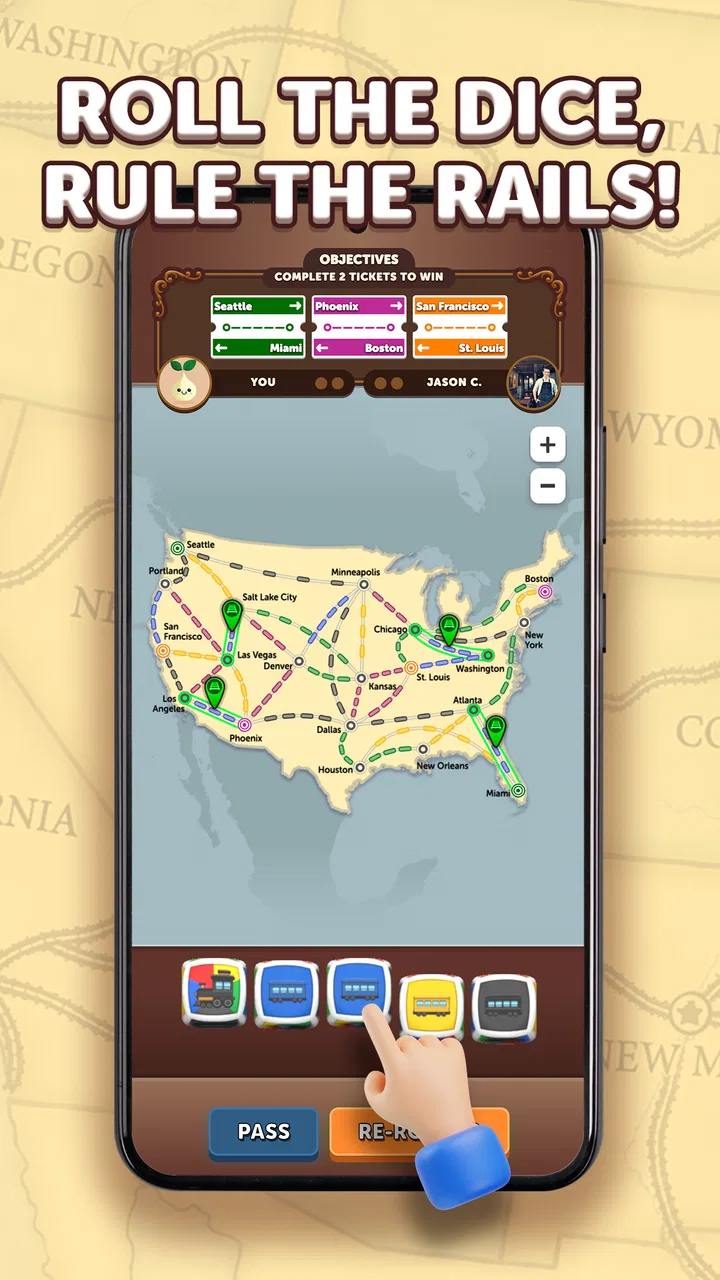
The central hook is simple. I roll dice, use the results to pursue train routes, and try to build a better network than the other players. That structure gives each turn a clear purpose, but the dice prevent the strongest plan from becoming automatic. I have to decide whether to chase the route I really want, adapt to what appears, or take a safer connection before another rival reaches it. That tension is the reason I kept coming back rather than treating each match as a one-time novelty.
How the USA map turns luck into decisions
The map gives the game its identity. A board showing routes across the United States makes progress easy to read, even when several things are happening at once. I can look at my existing lines, see where a rival is expanding, and quickly judge whether a new connection helps my overall position or merely fills space. That visual clarity matters in a mobile board game, where crowded interfaces can make otherwise simple choices feel tiring.
You May Also Like

 AccuWeather: Weather Radar
AccuWeather Review: A Quick, Clear Forecast for Everyday Decisions
For everyday plans, the best forecast is the one you can understand quickly. AccuWeather makes rain timing, radar, and local conditions easy to act on, with a few trade-offs.

 Hill Climb Racing
Why Hill Climb Racing Still Turns Crashes Into One More Run
A tiny car, a bumpy hill and one more upgrade: Hill Climb Racing keeps resurfacing because its simple chaos makes every near-miss feel personal.

 AliExpress - Shopping App
AliExpress Makes Global Shopping Feel Personal, but Shoppers Bear the Risk
AliExpress turns a global marketplace into a pocket-sized discovery engine. Its reach is useful, its shopping loop compelling, and its trade-offs easy to miss.

 Lords Mobile: Kingdom Wars
Lords Mobile Is a Kingdom-Building Routine, Not a Quick Match
A case-by-case verdict on the building, battles, device demands, and social commitments that make Lords Mobile rewarding for some players and exhausting for others.

 PDF Scanner app - TapScanner
TapScanner Makes Paperwork Easier to Capture, Check, and Share
TapScanner makes scanning with a phone feel less like a rescue operation and more like a dependable step in getting work done. Its capture tools are useful, though not flawless.

 Block Blast!
 Shows How Much a Puzzle Game Can Leave Out
A quiet grid game shows why puzzle players increasingly value instant clarity, repeatable skill and low-pressure play—and where the genre still needs to catch up.
More From Our News Desk
View All News


The dice are more than a decorative replacement for cards or tokens. They create a useful question every time I play: should I pursue an ambitious route that depends on a favorable result, or convert the current opportunity into dependable progress? That choice gives the game a different rhythm from a conventional route-building board game. In a traditional version, careful collection and planning may dominate the experience. Here, planning still matters, but it has to remain flexible.
My strongest matches were the ones where I started with a broad plan instead of a single fixed target. I looked for routes that could support more than one direction, then changed course when the dice made another option more practical. This is one of the less obvious lessons in the game: flexibility is usually more valuable than a perfect opening plan. A player who spends too long waiting for one exact outcome can lose useful territory while a less glamorous route keeps producing progress.
The USA setting also helps new players understand what they are doing without a long explanation. The route network gives every action a visible consequence. Even if someone has never played a train-themed board game, they can usually grasp the basic goal after watching a few turns. That makes it a reasonable choice for casual family play or for introducing a friend to digital board games.
Where the game feels strongest
The best part of the experience is the balance between immediate feedback and longer-term positioning. Rolling dice gives me something to react to right away, while the map encourages me to think about future connections. I am not simply tapping the most obvious button each turn. I am weighing route value, timing, and the risk of allowing a rival to close off an attractive path.
Rival pressure is especially important. A route is not valuable only because it helps my own network; it may also block another player from completing a useful chain. That turns apparently modest choices into meaningful defensive moves. Sometimes the correct decision is not the route with the biggest immediate benefit, but the one that prevents a competitor from gaining a much cleaner position.
This makes the game more interesting with players who pay attention. Against an inexperienced opponent, I can often follow my preferred plan comfortably. Against someone who notices the same openings, the map becomes much tighter. The result is a friendly kind of competition: I am not managing a huge collection of rules, but I am still watching the board and trying to predict what another player wants.
Another strength is accessibility. The game is free to download, carries an Everyone age rating, and runs on Android devices using version 7.0 or later. Those details make it easier to recommend to households with mixed devices, although the practical experience can still depend on the phone or tablet being used. I would not choose it solely because it is free, but the no-cost entry point lowers the risk of trying it with a friend or family member.
The developer, FunCraft Games, has kept the premise focused rather than burying the route contest under unrelated systems. That focus is welcome. I can start a session with a clear understanding of what matters: rolls, routes, timing, and rivals. The current version is 1.0.29, so anyone installing it should make sure the app has updated properly before judging the experience from an older build.
Small decisions that improve a match
One practical habit helped me play better: I stopped treating every roll as a command to continue my original objective. A poor result can still be useful if it reveals which nearby route is becoming available. Instead of repeatedly forcing an unlikely target, I treated the dice as information about the board. This reduced wasted turns and made my networks more coherent.
I also found it useful to value junctions and connecting routes, not just long-looking stretches. A route that links two parts of my position can be more helpful than one that appears impressive but leaves my network isolated. This is easy to miss when the map is busy. Before committing, I check whether the route improves future choices or merely gives me a temporary sense of progress.
A third tip is to watch the opponent’s direction rather than only their total expansion. If a rival repeatedly moves toward one region, I assume they have a reason and consider whether a nearby connection is strategically important. I do not block everything, because defensive play can waste opportunities, but I avoid handing over a route that completes their position too easily. That balance between building and interfering is where the game feels most like a board game rather than a simple dice roller.
For a short everyday session, the game fits naturally into a break or a relaxed evening. I can imagine two friends playing while waiting for food, or a parent introducing the map and route idea to a child who enjoys geography and competition. The turns are easy to discuss aloud: one player can explain why a route matters, while the other decides whether to take it or gamble on a better result. That conversational quality is a real advantage over more solitary puzzle games.
What may limit its appeal
The same randomness that keeps matches lively can frustrate players who want complete control. If I prefer games where careful preparation almost always beats bad luck, this may feel too unpredictable. A well-considered plan can be disrupted by an unfavorable roll, and there is no way to remove that uncertainty entirely. The game asks me to accept imperfect information and imperfect control as part of the fun.
That trade-off also means the experience may feel lighter than a full tabletop route-building game. Players who enjoy extended planning, elaborate scoring systems, or a large number of strategic layers may eventually want something more substantial. Here, the pleasure comes from making a few good choices under pressure, not from running a detailed railway company over a long campaign.
There is also a monetization consideration. The game is free, but optional in-app purchases range from ninety-nine cents to forty-nine dollars and ninety-nine cents per item. I would approach those purchases carefully. The basic game is the part I would evaluate first, and I would not spend simply because a difficult roll made me impatient. In a dice-based game, paying to escape frustration can weaken the very uncertainty that makes the matches engaging.
For families, I recommend agreeing on purchase expectations before handing over the device. The Everyone rating makes the game broadly suitable from an age perspective, but that does not automatically make every purchase decision suitable for every household. A simple device-level spending rule is sensible, particularly when children are sharing access.
The game is also not the best choice for someone looking for a quiet, purely solo experience unless they enjoy competing against board-game-style opposition. Its identity comes from rivals and contested routes. If my priority is meditation, wordplay, or a puzzle with no opponent pressure, I would choose a different category. Likewise, players who want a realistic train-management simulation should look elsewhere; this is a compact board contest built around routes and dice, not an operational railway game.
Compared with the usual alternatives in this category, the main distinction is the blend of route planning and dice resolution. A classic tabletop-inspired route game may reward a more controlled hand-management process, while a pure dice game may offer less meaningful geography. Ticket to Dice sits between those approaches. The map gives the rolls context, and the rolls stop the map from becoming a solved sequence. That makes it easier to start than a heavier strategy title, but less predictable than a game built mainly around deliberate planning.
Who should install it
I would recommend it to players who like board games but want a compact digital version with a clear theme. It suits people who enjoy taking calculated risks, adapting after an unlucky result, and watching a shared map change over the course of a match. It is particularly approachable for newcomers because the objective is visible and the route network gives every decision a concrete shape.
It is also a good fit for casual groups with different experience levels. A veteran can think about blocking and network efficiency, while a beginner can concentrate on making useful connections. That difference in depth is helpful: the rules remain approachable, but the board offers enough room for stronger players to make better choices.
I would skip it if I dislike random outcomes, become annoyed when another player takes a route first, or need a game with a long-term progression system. I would also skip it if I am specifically searching for a realistic railway simulator or a highly competitive strategy title where luck has only a minor role. The game is strongest when I see dice as a challenge to manage, not as an unfair interruption.
Its audience size is still modest, with more than ten thousand installs and an average rating of 4.4 from 188 ratings. Those figures suggest a positive early reception, but I would treat them as a starting signal rather than proof that it will suit everyone. The 45 written reviews can provide extra context for a prospective player, while my own recommendation remains conditional on enjoying this particular mix of chance and route control.
My final verdict
Ticket to Dice - Trains Tracks succeeds because it understands its scale. It does not need a giant rule set to create tension. A few dice, a USA map, and contested train routes are enough to make me reconsider my plan from one turn to the next. The game is at its most enjoyable when I play proactively but stay ready to change direction.
Its weaknesses are equally clear. Luck can outweigh careful preparation, the experience may feel too light for serious strategy fans, and the optional purchases deserve restraint. None of those points ruins the game, but they define the kind of player who will enjoy it. I would not present it as a replacement for a deep tabletop classic. I would present it as a friendly, accessible alternative for quick route-building matches.
My recommendation is simple: install it if you want a free board game that turns train-route planning into short decisions with real uncertainty. Start by learning to connect flexible parts of the map, observe where rivals are heading, and avoid chasing one perfect roll for too long. If that style of adaptation sounds enjoyable, FunCraft Games has made a focused little game worth trying. If you need total control or a detailed railway simulation, your time is better spent with another option.
FAQs for Ticket to Dice - Trains Tracks
01What is Ticket to Dice - Trains Tracks?
Ticket to Dice - Trains Tracks is a dice-based strategy and board game inspired by classic railway route-building games. Players roll dice, collect the required colors or symbols, and use them to claim train routes on a map. The objective is usually to connect destinations, complete tickets, and score more points than opponents while making efficient decisions with limited opportunities.
02How do you play Ticket to Dice - Trains Tracks?
Gameplay generally revolves around rolling dice and using the results to build railway connections between cities or locations. You must decide whether to spend your available dice on short routes, save them for longer connections, or pursue destination objectives. Planning is important because other players may claim valuable tracks first, while unfinished tickets can reduce your final score.
03Can Ticket to Dice - Trains Tracks be played offline?
The availability of offline play may depend on the specific version, mode, and device. Some board-game adaptations allow solo play against computer-controlled opponents without an internet connection, while online multiplayer, advertisements, cloud features, or account services may require access to the internet. It is best to check the game description and test the selected mode before traveling or playing offline.
04Does the game support multiplayer?
Ticket to Dice - Trains Tracks may offer multiplayer options depending on the edition and platform, such as local play, online matches, or games against artificial intelligence. Multiplayer is usually the most competitive way to experience the game because opponents can block routes and race for the same objectives. Check the available modes, player limits, and account requirements before downloading.
05Is Ticket to Dice - Trains Tracks suitable for beginners and children?
The game can be approachable for beginners because its basic actions—rolling dice, collecting results, and claiming routes—are easy to understand. However, successful play also requires planning, probability management, and awareness of opponents’ moves. Younger children may need help reading objectives or calculating scores, so suitability depends on their age, reading ability, and familiarity with strategy board games.
Pros
- Simple rules make it easy for new players to start quickly.
- Short matches fit well into brief gaming sessions.
- Strategic route choices add depth beyond basic dice rolling.
- Colorful visuals make the board easy to read on smaller screens.
- Suitable for casual play with friends and family.]
- contras
- items
- description
- Pros about the app.
- Contras about the app.
- Ticket to Dice - Trains Tracks may feel repetitive after extended play.
- Random dice results can sometimes outweigh careful planning.
- Limited content may reduce long-term replay value for dedicated players.
- The interface can feel cramped on smaller phone displays.
- Online features or multiplayer options may not suit every player’s expectations.
Cons
- Ticket to Dice - Trains Tracks may feel repetitive after extended play.
- Random dice results can sometimes outweigh careful planning.
- Limited content may reduce long-term replay value for dedicated players.
- The interface can feel cramped on smaller phone displays.
- Online features or multiplayer options may not suit every player’s expectations.

Ticket to Dice - Trains Tracks
Gallery